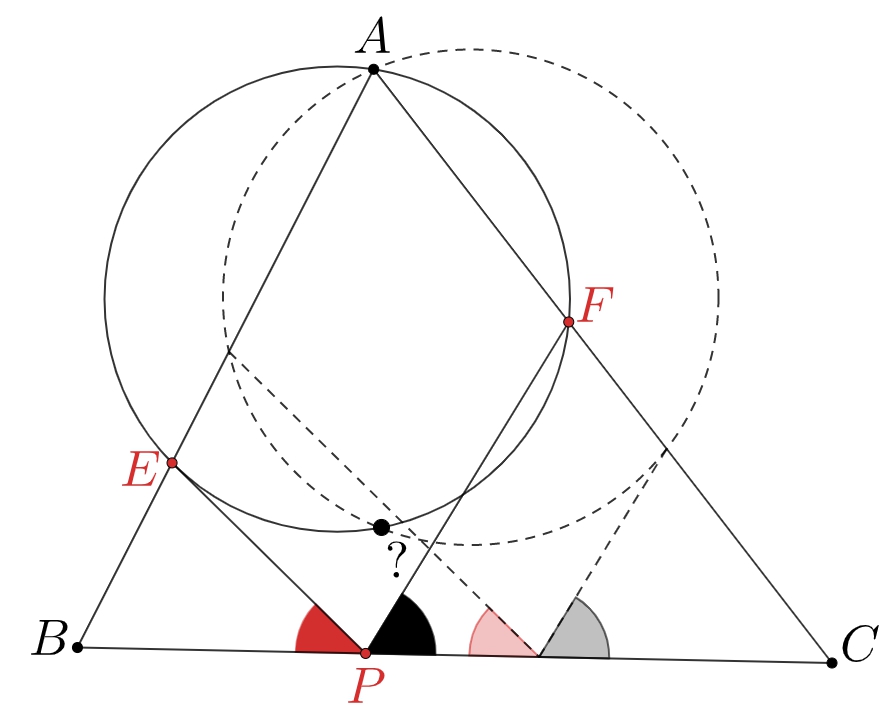
Variable then fixed.
In this post, I will go over some "unusual" problems in olympiad geometry. In my opinion, these problems are the most unique geometry problems since they require proof of something nonstandard other than "Prove $\angle A = \angle B$" or "Prove that $A,B,C$ are collinear". They ask the question: What happens when we vary some part of the picture? How does the rest of the picture react to those movements and how does one specific object behave under these changes?
The keyword for these problems is the locus. In this context, the locus represents the path the object traces as the diagram changes under some movement. In most problems, the setting is like this:
- You are given a diagram.
- One of the points varies on some line or circle.
- You are asked to determine the locus of some object as that point moves. Sometimes you just need to prove that the object lies on a fixed line or passes through a fixed point instead of determining the object exactly.
Usually, the changes are simple. Usually points vary on lines/circles or a line varies through a point. The way to approach these problems:
- Observe which point moves and how that movement roughly corresponds to the movement of the object whose motion we want to describe.
- Try moving the variable point into border cases from which we can glean insight into what's happening. Often it makes sense sending a point to infinity along a line.
- Guess the locus. This is usually a circle, line, or in general a conic. Usually you first need to find which conic you're looking for (i.e. which circle or line).
- Prove your guess. This is usually the hardest part of the question.
It is very abstract without computer aid (GeoGebra) to visualize but it is very satisfying when you can figure out what's happening from just playing around with border/edge cases.
Introductory example
On the sides of the scalene acute $\Delta ABC$, choose the points $X \in AB$ and $Y \in AC$ so that $BX = CY $. Prove that, regardless of the choice of points $X$ and $Y$, the circle circumscribed around $\Delta AXY$ passes through some fixed point other than $A$.

Solution: First, we notice that as $X,Y$ move towards $A$ the circumcircle $AXY$ also moves towards $A$. If we let $BX=CY=0$ we get that the circumcircle of $AXY$ is the same as $ABC$ so the fixed point must lie on the circumcircle of $ABC$. Pushing $X$ into $A$ we get a circle tangent to $AB$ at $A=X$. Let the intersection of this circle and the circumcircle of $ABC$ be $N$. Inspecting angles we easily find $\triangle BAN \equiv \triangle CYN$ so we have $BN=CN$. If the problem is correct, then this point must be the fixed point i.e. the point on circumcircle $ABC$ for which $BN=CN$ holds (note that $AXY$ cuts $ABC$ above $BC$ so it can't be the smaller midarc). It's not hard to notice that in general $\triangle BXN \cong \triangle CYN$ where $N$ is the midarc $BAC$ by the same angle chasing. Thus $AXYN$ is always cyclic, and thus this is our desired fixed point (the midarc $BAC$).
Notice also that this means the circumcenter of $AXY$ lies on a fixed line (the bisector of chord $AN$). Prove that this line is parallel to the angle bisector of $BAC$ and "find" its intersection with $BC$.
Often, problems about circles passing through fixed points can be interpreted as their center lying on a fixed line if the circles are mutually coaxial (have the same chord in our case, i.e. 2 fixed points).
Remark
The above problem remains true if point $X$ is between $A,B$ and $C$ is between $A,Y$ (outside triangle $ABC$). In this case, the fixed point is the midarc $BC$ without $A$. Geometry likes to have two versions of the same thing for two similar points (for example, if something holds for the incetner, something similar probably holds for the excenter).
Before I go any further, I'll state some terms that are used further into the post. You can still understand everything, but for the people that want to search them up: trigonometric ptolomey, spiral similarity, gliding principle.
Now I showcase some strikingly similar problems:
- (JBMO SHL 2016) Let ${ABC}$ be an acute angled triangle whose shortest side is ${BC}$. Consider a variable point ${P}$ on the side ${BC}$, and let ${D}$ and ${E}$ be points on ${AB}$ and ${AC}$, respectively, such that ${BD=BP}$ and ${CP=CE}$. Prove that, as ${P}$ traces ${BC}$, the circumcircle of the triangle ${ADE}$ passes through a fixed point.
- (USATST 2012) In acute triangle $ABC$, $\angle{A}<\angle{B}$ and $\angle{A}<\angle{C}$. Let $P$ be a variable point on side $BC$. Points $D$ and $E$ lie on sides $AB$ and $AC$, respectively, such that $BP=PD$ and $CP=PE$. Prove that as $P$ moves along side $BC$, the circumcircle of triangle $ADE$ passes through a fixed point other than $A$.
- (ARMO 2001) Let $N$ be a point on the longest side $AC$ of a triangle $ABC$. The perpendicular bisectors of $AN$ and $NC$ intersect $AB$ and $BC$ respectively in $K$ and $M$. Prove that the circumcircle of triangle $KBM$ passes through a fixed point other than $B$.
- (ELMO 2013) In $\triangle ABC$, a point $D$ lies on line $BC$. The circumcircle of $ABD$ meets $AC$ at $F$ (other than $A$), and the circumcircle of $ADC$ meets $AB$ at $E$ (other than $A$). Prove that as $D$ varies, the circumcircle of $AEF$ always passes through a fixed point other than $A$, and that this point lies on the median from $A$ to $BC$.
- (USATST 2008) In acute triangle $ABC$, $\angle{A}$ is the smallest . $P$ be a point on side $BC$. Points $D$ and $E$ lie on sides $AB$ and $AC$, such that $PD$ and $PE$ are parallel to two given straight lines. Prove that as $P$ moves along $BC$, the circumcircle of triangle $ADE$ passes through a fixed point other than $A$.
Take a second and realize the immense similarity of the problems above. Their respective "outline" solutions:
- Problem 1
- It's the incenter $I$. This problem is also known as Sparrow's lemma. The solution is a few cyclic quads and some angle chasing.
- Problem 2
- It's the orthocenter $H$. Can be done by gliding principle and (or) similarities.
- Problem 3
- It's the circumcenter $O$. Pretty similar to the previous problem, best look at the link for solutions.
- Problem 4
- It's the Humpty point. This is one of those classic problems when learning Humpty/Dumpty point configurations.
- Problem 5
- It's the Dumpty point. This is the conjugate case of the above problem. Notice that in this problem we have parallel lines and in the previous one we had anti-parallel lines. Cute.
The point
All three of these problems share the same vibe. They all have something "uniformly" moving within them. In fact we can formalize this intuition and solve all 5 problems with one generalization:
Generalization
In triangle $ABC$, let $P$ be a point on side $BC$. Points $E,F$ are given on sides $AB,AC$ such that $\angle BPE = x$ and $\angle CPF = y$ where $x,y \in [0,2\pi]$. The circumcircle of triangle $AEF$ passes through a fixed point $S$.

Another interesting way to look at this is that the circumcenter of triangle $AEF$ always lies on a fixed line. This is evident since all these circles should be coaxial with axis $AS$.
The points $E,F$ are said to be moving "Uniformly" on lines $AB,AC$ respectively, which means that they move at the same velocity.
Uniformity
Let $P$ be a point varying on segment $AB$. The point $P$ is moving uniformly on $AB$ if at time $t$; $\overrightarrow{AP} = t \cdot \overrightarrow{AB}$.
The big picture
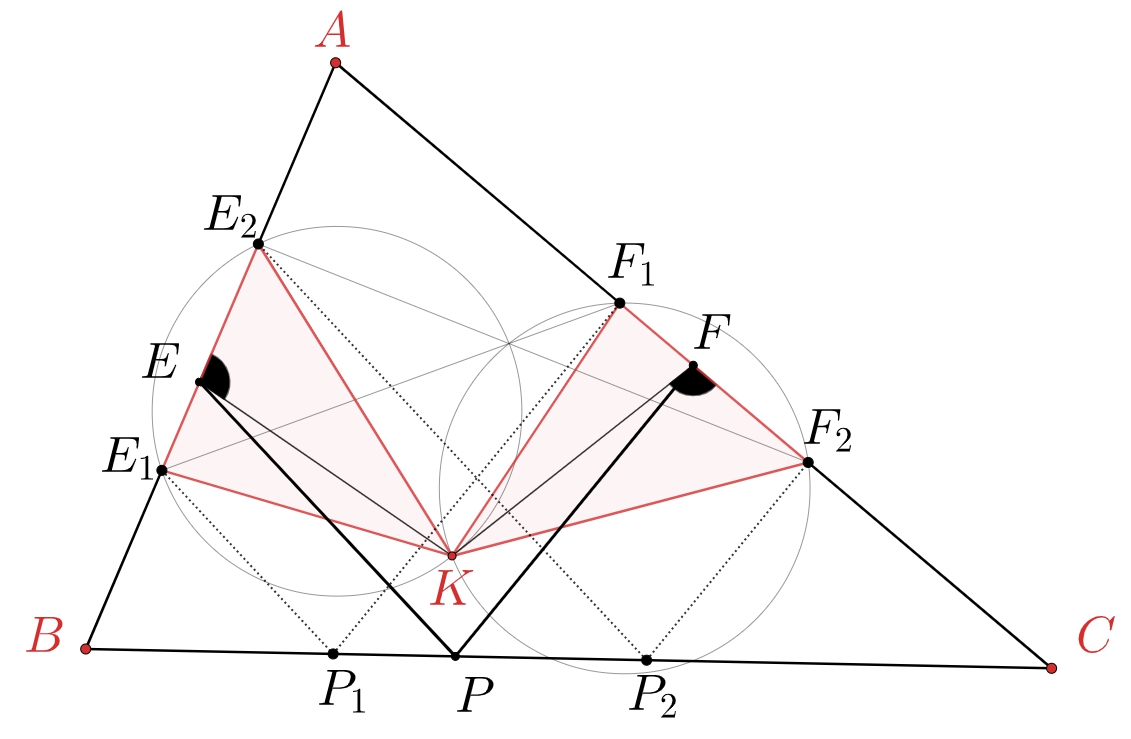
First approach - Spiral similarity Take two sample values $P_1,P_2$ and the corresponding $E_1,F_1,E_2,F_2$. Let $K$ be the point in the plane such that $\triangle KE_1E_2 \sim \triangle KF_1F_2$ in that order (the spiral center). Obviously $\triangle KEE_2 \sim \triangle KFF_2$ (by Gliding principle or simply by ratio calculations) and now we're done by the black angles. Our $AEF$ circle passes through $K$ without regard of $P$. In this case, it might be more natural to look at the spiral similarity centered at $K$ sending $E_1 \rightarrow E_2$ and $F_1 \rightarrow F_2$ which is obvious by Gliding principle.
Second approach - Trigonometric Ptolomey's theorem Trig Ptolomey states that points $A,B,C,D$ are cyclic if and only if
(this is not the full general case). So if we want our circle $AEF$ to pass through some fixed point $S$, this relation must hold: Using Law of Sines and some algebraic manipulation this is easily shown to hold for the above problem.Third approach - Lemma about fixed point Let $\angle pAq$ be given in the plane. Let $X,Y$ vary on $p,q$ respectively. If $c_1 \cdot AX + c_2 \cdot AY = c_3$ (a fixed linear combination of the line segments $AX,AY$ is constant) for all positions of $X,Y$ then the set of circles $AXY$ which satisfy this property pass through a fixed point. For a proof of this claim one can take two samples of points $X_1,Y_1$, $X_2,Y_2$ and intersect the circles $AX_1Y_1$ and $AX_2Y_2$ and prove that this is the common point for all such circles by spiral similarities.
Turns out one can fully characterise this fixed point (with respect to the triangle $ABC$ and fixed points). To see this, solve Advanced Problem 1 below.
Exercise problems
If you're like me, you like finding connections between seemingly very different things. In this case, we investigate the connections between the above problems and various other problems that have appeared in math olympiads before.
A Sharygin problem restated
Let $ABC$ be an acute triangle. Let $D$ be a point on the arc $BC$ without $A$. Let $P,Q$ be points on $BC$ such that $\angle BDP = \angle CDQ$. Find the locus of the circumcenter of triangle $APQ$ as $P,Q$ vary on $BC$.

Solution:
Notice the similarity with the introductory problem. Extending the definition of $P,Q$ and sending them to infinity we might guess that the locus is a line. This means the circle must passs through a fixed point for all $P,Q$. Letting $P,Q$ be $B,C$ respectively, we get that $\odot APQ \equiv \odot ABC$ thus the fixed point must lie on $\odot ABC$. Keeping this in mind, we know that the radical axis of this circle $APQ$ cuts $BC$ at a fixed point (common trick to extend radical axis to $BC$) since $A$ and that mysterious point are fixed. So we need to prove that there exists a point on $BC$ which has equal power with respect to $ABC$ and $APQ$ since that point would always be fixed and lie on $BC$ thus making the mysterious point exist. Which point to take? Let that point be $T$. We need $TP\cdot TQ = c$ for power of point to work. Actually, this $c$ has to be $TB \cdot TC$. Now switch focus to triangle $DPQ$. We have $DP,DQ$ isogonal in angle $BDC$ which means the circumcenter of this triangle lies on a fixed line (note that $AH,AO$ are isogonal where $H$ is the orthocenter of a general triangle). Thus if we let $T$ be the point on $BC$ such that $TD$ is tangent to $DPQ$ we have $T$ is fixed since $TD$ is perpendicular to the line connecting $D$ and the circumcenter of triangle $DPQ$ (notice also that $DPQ$ touches $ABC$ at $D$). Looking at power of point from this $T$ we have $TD^2 = TP \cdot TQ = TB \cdot TC$ which is what we desired to prove.
Linear variant of the gliding principle
Let $A$ be a fixed point and $B$ be on a fixed line. If we vary $B$ on that line, any other given point $C$ such that $ABC$ has fixed shape will lie on a fixed line.

Circular variant of the gliding principle (Spiral similarity)
Let $A$ be a fixed point and $B$ be on a fixed circle. If we vary $B$ on that circle, any other given point $C$ such that $ABC$ has fixed shape will lie on a fixed circle.

External tangents locus (own, inspired)
Let $ABC$ be an acute triangle. Let $P$ be a point on side $BC$. Let the external tangents to the circmucircles of triangles $ABP$ and $ACP$ intersect at $S$. Find the locus of $S$ as the point $P$ varies on $BC$.

Solution:
Moving point $P$ doesn't seem too useful at first glance. The only thing we can infer is that the locus will probably be a line since by "extending" the definition of $P$ we can place $P$ at infinity along line $BC$ and get a point $S$ infinitely far from
triangle $ABC$ (a common trick). Now we try to guess what that line is. Exploring the picture, we notice that $S$ is the center of homothety of these two circles. Homothety implies the following ratio:
\[ \frac{SO_1}{SO_2} = \frac{R_1}{R_2}, \]
here $R_1,R_2$ are the radii of the circumcircles of triangle $ABP, APC$ respectively. Notice also that $R_1 = AO_1$ and $R_2 = AO_2$ which means:
\[ \frac{SO_1}{SO_2} = \frac{AO_1}{AO_2}, \]
which implies that $AS$ is the external angle bisector of angle $O_1AO_2$ i.e. $S$ lies on the Apollonius circle of triangle $AO_1O_2$.
Notice also that $AO_1O_2$ is similar to $ABC$ since $\angle BAO_1 = \angle CAO_2$ which implies $\angle O_1AO_2 = \angle BAC$ and because $\angle AO_1O_2 = \frac{\angle AO_1P}{2} = \angle ABP = \angle ABC$.
This implies that $AO_1O_2$ has constant shape and also that $ASO_2$ has constant shape (same angles no matter the position of $P$). Now simply notice that $O_2$ lies on a fixed line (the bisector of $AC$) and thus
$S$ also lies on a fixed line by the Variant of the gliding principle above.
Note that we didn't determine which line this is, just that it exists. One can prove that this line is the bisector of the segment $AT$ where $T$ is the foot of the external angle bisector of $BAC$.
Practice problems
Introductory
- Problem 1 (JBMO Shortlist)
- Let ${ABC}$ be an acute angled triangle whose shortest side is ${BC}$. Consider a variable point ${P}$ on the side ${BC}$, and let ${D}$ and ${E}$ be points on ${AB}$ and ${AC}$, respectively, such that ${BD=BP}$ and ${CP=CE}$. Prove that, as ${P}$ traces ${BC}$, the circumcircle of the triangle ${ADE}$ passes through a fixed point.
- Problem 2 (Folklore)
- Let two circles $\omega_1, \omega_2$ intersect at $A,B$. A line passing through $A$ intersects $\omega_1, \omega_2$ in points $P,Q$. Prove that the bisector of $PQ$ passes through a fixed point.
- Problem 3 (USAJMO)
- The isosceles triangle $\triangle ABC$, with $AB=AC$, is inscribed in the circle $\omega$. Let $P$ be a variable point on the arc $\stackrel{\frown}{BC}$ that does not contain $A$, and let $I_B$ and $I_C$ denote the incenters of triangles $\triangle ABP$ and $\triangle ACP$, respectively.
Prove that as $P$ varies, the circumcircle of triangle $\triangle PI_BI_C$ passes through a fixed point. - Problem 4 (Sawayama Thebault's theorem)
- Let $ABC$ be a triangle. Let $P$ be a variable point on side $BC$. The circle tangent to $AP,BC$ and the circumcircle of triangle $ABC$ is $\omega$. Let $\omega$ touch $AP,BC$ at points $U,V$. Prove that $UV$ passes through a fixed point as $P$ varies on side $BC$.
- Problem 1 (Saint Petersburg Olympiad)
- Let $ABC$ be an acute triangle. Variable point $X$ lies on segment $AC$, and variable point $Y$ lies on the ray $BC$ but not segment $BC$, such that $\angle ABX+\angle CXY =90$. Point $T$ is the projection of $B$ on $XY$. Prove that all points $T$ lie on a fixed line.
- Problem 2 (IMO Shortlist)
- Let $D$ be the foot of perpendicular from $A$ to the Euler line (the line passing through the circumcentre and the orthocentre) of an acute scalene triangle $ABC$. A circle $\omega$ with centre $S$ passes through $A$ and $D$, and it intersects sides $AB$ and $AC$ at $X$ and $Y$ respectively. Let $P$ be the foot of altitude from $A$ to $BC$, and let $M$ be the midpoint of $BC$. Prove that the circumcentre of triangle $XSY$ is equidistant from $P$ and $M$.
- Problem 3 (Own)
- Let $ABC$ be an acute triangle. Points $P,Q,R$ are on the circumcircle of triangle $ABC$ such that $\angle BAP = \angle CBQ = \angle ACR$. Prove that the circumcenter of the triangle formed by the lines $AP,BQ,CR$ lies on a fixed circle.
- Problem 4 (Turkey EGMO TST)
- Let $X$ be a variable point on the side $BC$ of a triangle $ABC$. Let $B'$ and $C'$ be points on the rays $XB$ and $XC$, respectively, satisfying $B'X=BC=C'X$. The line passing through $X$ and parallel to $AB'$ cuts the line $AC$ at $Y$ and the line passing through $X$ and parallel to $AC'$ cuts the line $AB$ at $Z$. Prove that all lines $YZ$ pass through a fixed point as $X$ varies on the line segment $BC$.
- Problem 1 (USA EGMO TST)
- Let $ABC$ be a triangle and let $P$ be a point not lying on any of the three lines $AB$, $BC$, or $CA$. Distinct points $D$, $E$, and $F$ lie on lines $BC$, $AC$, and $AB$, respectively, such that $\overline{DE}\parallel \overline{CP}$ and $\overline{DF}\parallel \overline{BP}$. Show that there exists a point $Q$ on the circumcircle of $\triangle AEF$ such that $\triangle BAQ$ is similar to $\triangle PAC$.
- Problem 2 (IMO Shortlist)
- Given a triangle $ABC$. The points $A$, $B$, $C$ divide the circumcircle $\Omega$ of the triangle $ABC$ into three arcs $BC$, $CA$, $AB$. Let $X$ be a variable point on the arc $AB$, and let $O_{1}$ and $O_{2}$ be the incenters of the triangles $CAX$ and $CBX$. Prove that the circumcircle of the triangle $XO_{1}O_{2}$ intersects the circle $\Omega$ in a fixed point.
- Problem 3 (Polish MO)
- Let $\omega$ be the circumcircle of a triangle $ABC$. Let $P$ be any point on $\omega$ different than the verticies of the triangle. Line $AP$ intersects $BC$ at $D$, $BP$ intersects $AC$ at $E$ and $CP$ intersects $AB$ at $F$. Let $X$ be the projection of $D$ onto line passing through midpoints of $AP$ and $BC$, $Y$ be the projection of $E$ onto line passing through $BP$ and $AC$ and let $Z$ be the projection of $F$ onto line passing through midpoints of $CP$ and $AB$. Let $Q$ be the circumcenter of triangle $XYZ$. Prove that all possible points $Q$, corresponding to different positions of $P$ lie on one circle.
- Problem 4 (Czech-Polish-Slovak match)
- Circles $\Omega_1$ and $\Omega_2$ with different radii intersect at two points, denote one of them by $P$. A variable line $l$ passing through $P$ intersects the arc of $\Omega_1$ which is outside of $\Omega_2$ at $X_1$, and the arc of $\Omega_2$ which is outside of $\Omega_1$ at $X_2$. Let $R$ be the point on segment $X_1X_2$ such that $X_1P = RX_2$. The tangent to $\Omega_1$ through $X_1$ meets the tangent to $\Omega_2$ through $X_2$ at $T$. Prove that line $RT$ is tangent to a fixed circle, independent of the choice of $l$.